
Estimated reading time: 8 minutes
Gaslighting is a powerful form of emotional manipulation. 74% of people have experienced gaslighting at some point in their lives. Yet, many don’t even realize it’s happening.
That’s what makes it so dangerous.
It can chip away at your confidence, distort your sense of reality, and leave lasting scars.
But here’s the thing: the effects of gaslighting go deeper than you might think.
Today, we’ll explore what is gaslighting, 7 negative effects of gaslighting in relationships, and tips on how to deal with it.

What is Gaslighting?
Gaslighting is a psychological abuse form where a person systematically creates a false reality and you feel trapped in the this maze. This manipulation often occurs in relationships and can lead to feelings of confusion, insecurity, and even paranoia.
Gaslighting as a Systemic Issue in 2025
Recent sociological studies highlight gaslighting not just as interpersonal but deeply tied to systemic power dynamics. For instance, marginalized groups—particularly women, racial communities, and the economically disadvantaged—experience gaslighting rooted in societal structures. This goes beyond individual interactions, as institutions often reinforce dismissive narratives, eroding victims’ realities.
Power Dynamics at Play
Gaslighting thrives where unequal power structures exist. Relationships influenced by disparities—whether at work, home, or in society—create environments ripe for manipulation, perpetuating cycles of doubt and control.
How does Gaslighting work?
Gaslighting usually begins with small alterations to the truth, which are repeated over time until you start to doubt your memory and sense of reality.
Now, the abuser may start to accuse you of being volatile or emotionally unstable, even when there is no evidence to support these claims.
The goal of gaslighting is to make the target feel so overwhelmed and confused that you lose control over your life, emotions, and thoughts.
- Gaslighting is often to keep you under control or submissive.
- It can happen gradually over time and may start with small lies.
- The perpetrator will use manipulative tactics to make you feel like they can’t trust their thoughts and feelings.
As a result, gaslighting can have serious consequences, including lower self-esteem and anxiety disorders.
Types of Gaslighting
There are different types, but all of them share the same goal: to erode the victim’s trust and confidence in their sanity.
They do this by manipulating information, making it difficult for you to know what is true, and discrediting any attempts made by you to confront or speak out against your abuser.
Some of the most common types of gaslighting include:
- Verbal gaslighting is when the abuser manipulates the words spoken to them. It can involve twisting the meanings of words or sentences or even making up new stories based on what was said. It can also involve accusing you of lying or being chaotic.
- Emotional gaslighting is when the abuser gaslights by manipulating your emotions. They may try to make you feel ashamed, scared, or angry to control them. They may also try to make you feel responsible for everything that goes wrong in their relationship.
- Psychological gaslighting is when the abuser makes you doubt your thoughts and feelings. It can involve denying anything bad has ever happened or telling them they’re imagining. The abuser may even try to convince you that you are reckless in some way.
Signs that you are a Victim of Gaslighting.
It can be very difficult to tell when it is happening. It happens subtly and without you being aware.
These are gaslighting red flags.
However, some key signs may indicate that someone is gaslighting you when you,
- Self-doubt your thoughts and feelings.
- Start to doubt your self-worth and the reality of the situation.
- Feel like you’re going wild and lose your sense of self.
- Feel like you can’t rely on your judgment or senses.
- Begin to question your partner’s motives on anything.
- Feel like you’re constantly under attack.
- Become very defensive of yourself.
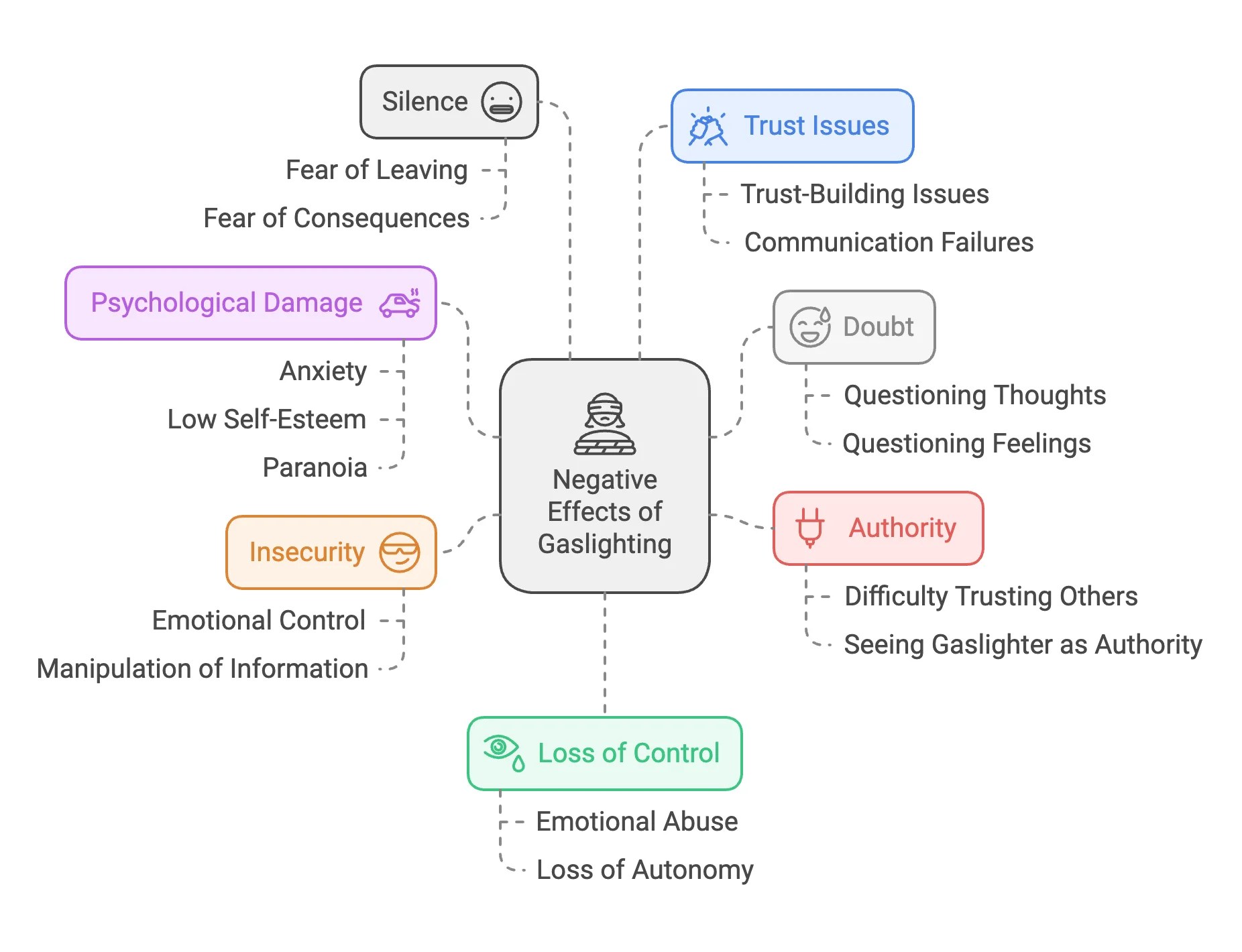
7 Negative effects of gaslighting in relationships
Time needed: 5 minutes
If you’re ever in a relationship where gaslighting is happening, it’s important to know the seven negative effects of gaslighting.
Gaslighting devastates the victim’s mental and emotional health and can even lead to a psychologically abusive relationship.
Here are the seven ways gaslighting can trouble you in relationships:
- You will start to doubt your experience.
You may start to doubt their thoughts, feelings, and experiences – this is known as cognitive dissonance.
- Partner will act as an authority
You may start to see the gaslighter as a towering figure of authority, which makes it difficult to form trusting relationships in the future.
- Your insecurity deepens
The gaslighter may control your emotions, and manipulation of information can increase the your sense of insecurity.
- Fearful silence
You may be reluctant to speak up or leave the relationship, fearing the worse.
- Psychological damage begins
Gaslighting may eventually cause long-term psychological damage, leading to feelings of anxiety, low self-esteem, and paranoia.
- Trust issues and communication failure
You may suffer from relationship dysfunction, such as difficulty in trust-building and maintaining healthy communication.
- You lose complete control on self
Finally, gaslighting can lead to emotional abuse – meaning that the gaslighter is deliberately hurting or abusive towards you to gain control.
Frequently Asked Questions
Yes, it may take some time and effort to recover – they eventually will move on and start fresh. Remember, it is a healing process.
There are a few things that victims of gaslighting need to remember to overcome the trauma (PTSD) they’ve experienced.
The first step is to start keeping track of the incidents (events, domestic violence). Write down what happened and when it happened.
Another important thing you can do is talk about your experiences with somebody who will understand. Talking about gaslighting can be incredibly difficult, but it’s vital if you want to protect yourself from it in the future. Talking about how you’re feeling will also help others notice if something seems off or out of place, which could lead to them being able to stop the gaslighting before it gets too bad.
Yes, gaslighting can have several negative long-term effects on your mental health, including increased anxiety and stress. It can also lead to depression, eating disorders, and even suicide.
INDIA – Health Collective
US – National Domestic Violence Hotline
UK – My CWA
AUS – Relationships Australia
PHILIPPINES – Domestic Shelters
MALAYSIA – Women’s Aid Organisation
Gaslighting is a form of emotional manipulation where one person makes another doubt their perceptions, memories, or beliefs. This behavior often involves denial, outright lying, and reality questioning, leading the victim to feel confused and unsure of themselves. Common tactics include insisting that the victim said or did things they did not, dismissing their feelings as irrational, and twisting facts to shift blame onto them1[3]5.
An example of gaslighting could be a partner denying they made a hurtful comment, despite the victim clearly remembering it. They might say, “You’re just being too sensitive,” or “I never said that!” This response not only denies the reality of the situation but also invalidates the victim’s feelings, causing them to question their own memory and emotional responses2[4]5.
To gaslight someone means to manipulate them into questioning their own reality or sanity. This can involve a range of behaviors such as lying about past events, dismissing their feelings, or suggesting they are imagining things. The goal is often to gain control over the victim by undermining their confidence and sense of self1[3]6.
You may be a gaslighter if you frequently:
– Dismiss others’ feelings or perceptions as irrational.
– Lie about events even when confronted with evidence.
– Shift blame onto others instead of taking responsibility.
– Use tactics that make others feel confused or question their sanity.
– Self-reflection and feedback from trusted individuals can help identify these behaviors3[4]5.
Conclusion
If you’re feeling victimized and confused, it may be because you’re experiencing gaslighting.
This mental manipulation tactic is used to control and manipulate people and can harm mental and physical health.
So, understanding what gaslighting is, how to identify it, and what you can do to protect yourself, you can start rebuilding your mental health foundation.
Hoomale is a hub of thought-provoking blogs on various subjects, from company operations to the mindset and behavior of young people to future work and tech. Stay informed and educated with our captivating reads.
Get notified of our next post via email by signing up with the form below! Follow us on YouTube.
Get your free subscription to Hoomale Newsletter now.
Disclaimer: Our post may contain affiliate links. By clicking and purchasing, the commission could come our way at no extra cost. Rest assured – we only endorse products and services with a personal stamp of approval and top-notch quality. Appreciation for your support runs deep.


