
Estimated reading time: 8 minutes
SecOps is a game changer. According to IBM’s 2023 report, cyberattacks cost businesses an average of $4.45 million per incident. That’s not just a dent in the budget; it’s a full-blown disaster.
But here’s the kicker: most of these breaches could have been mitigated—or even avoided entirely—with the right collaboration between IT and security teams.
That’s where SecOps comes in.
Let’s say, seamless coordination, faster incident response, and security are embedded in every layer of your operations. SecOps isn’t about adding complexity; it’s about making your processes leaner, faster, and far more secure.
If you’re still treating IT and security like separate worlds, you’re playing catch-up.
Let’s change that. Shall we?
This guide teaches you how to build a SecOps strategy that protects your business and boosts efficiency.

What is SecOps? A Simple Overview
SecOps (Security Operations) is a collaborative approach that integrates security practices into IT operations, ensuring that security is embedded into the lifecycle of systems, software, and infrastructure.
In an increasingly complex threat landscape, SecOps aligns security and IT teams to detect, manage, and mitigate threats in real-time. This approach streamlines workflows, improves incident response, and enhances the overall security posture of an organization.

Why SecOps is Critical for Modern Enterprises
In 2023 alone, 41% of the small businesses dealt with cyberattacks.
The rise of sophisticated cyberattacks and the expansion of digital transformation initiatives have created a need for seamless collaboration between security and operations.
SecOps addresses this by ensuring that security is no longer an afterthought but an integral part of every operational process.
Key benefits of SecOps include:
- Proactive Threat Management: With SecOps, organizations can anticipate and prevent attacks before they occur.
- Improved Incident Response: Faster detection and response to incidents reduce downtime and potential damage.
- Enhanced Collaboration: Fosters a culture of shared responsibility between IT and security teams.
- Operational Efficiency: Automating security tasks frees up time and resources for strategic initiatives.
Check out these free tools by Sophos.

The Evolution of SecOps
Earlier, IT operations and security teams worked in silos which led to slow response times and unaddressed vulnerabilities.
Now, as organizations shifted to more agile and scalable technologies, the need for real-time threat detection and response became apparent.
SecOps emerged as a response to this gap, breaking down silos and fostering collaboration to ensure security is integrated throughout the IT lifecycle.
Key Principles of SecOps
SecOps is built on several core principles that drive its effectiveness in modern organizations:
- Continuous Monitoring: All systems, applications, and networks are continuously monitored to detect and respond to threats in real-time.
- Automation: Automating security tasks, such as patch management, vulnerability scanning, and compliance checks, improves response times and reduces human error.
- Collaboration: Strong communication between IT and security teams is critical for addressing vulnerabilities quickly and efficiently.
- Integration: Security tools and practices are integrated into IT workflows to ensure that security is maintained throughout the development and operational stages.

Building a Strong SecOps Team
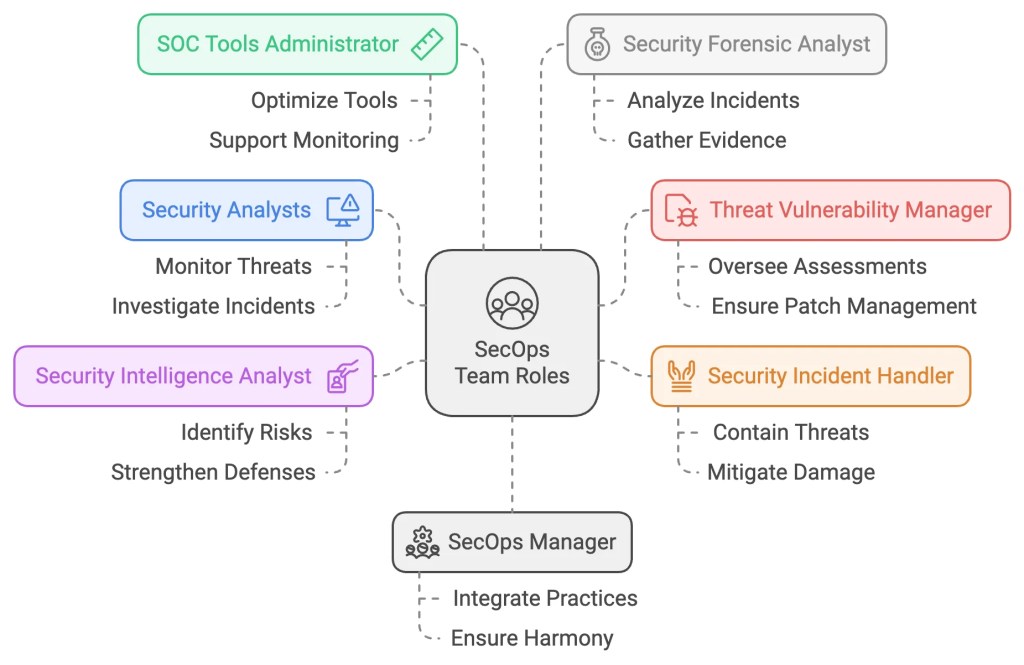
Implementing a successful SecOps strategy requires a well-coordinated team with a blend of IT and security expertise. The following roles are crucial:
- Security Analysts: Monitor and investigate potential threats, responding to incidents as they arise.
- Threat Vulnerability Manager: Oversee vulnerability assessments and ensure timely patch management to minimize security risks.
- Security Incident Handler: React swiftly to security incidents, containing and mitigating threats to minimize damage.
- Security Intelligence Analyst: Leverage threat intelligence to identify potential risks and strengthen defensive measures.
- SOC Tools Administrator: Maintain and optimize the security operations center (SOC) tools to support real-time monitoring and incident response.
- Security Forensic Analyst: Conduct forensic investigations to analyze security incidents, gather evidence, and determine the root cause of breaches or attacks.
- SecOps Manager: Oversees security integration practices into IT operations and ensures both teams work in harmony.
SecOps Best Practices for Enhanced Security
Time needed: 5 minutes
To ensure a robust SecOps environment, organizations should follow these best practices:
- Adopt a Zero Trust Model
A zero-trust approach means that no user or device is trusted by default, regardless of whether inside or outside the organization’s network. Continuous verification is required for every access request, minimizing potential security risks.
- Use Security Information and Event Management (SIEM)
SIEM tools allow organizations to collect and analyze security data from various sources, providing real-time insights into potential threats and streamlining incident response.
- Prioritize Threat Intelligence
Using threat intelligence tools, organizations can gain visibility into emerging threats and trends, allowing them to adjust their security measures.
- Automate Incident Response
Automating incident response allows for faster containment of threats, reducing the time hackers have to exploit vulnerabilities.
Common Challenges and How to Overcome Them
While the benefits of SecOps are clear, there are challenges organizations must overcome to realize its potential fully:
- Cultural Resistance: Aligning IT and security teams requires breaking down long-standing silos and fostering a culture of collaboration.
- Tool Integration: Integrating disparate tools used by IT and security teams can be difficult, but adopting platforms that support both functions is essential.
- Skill Gaps: Organizations may face a shortage of professionals skilled in IT operations and security, requiring ongoing training and investment in new talent.
Recommended Books To Strengthen SecOps Skills


SecOps in Action: Real-World Case Studies
Case Study 1: Financial Services Firm
A major financial institution implemented SecOps to reduce its incident response time. They reduced their average response time by 40%, significantly mitigating the impact of cyberattacks by automating threat detection and response processes.
Case Study 2: Healthcare Provider
A healthcare provider with a distributed IT infrastructure used SecOps to improve collaboration between IT and security teams. This allowed them to reduce system vulnerabilities and comply with strict healthcare regulations.
The Future of SecOps: Trends to Watch
As technology continues to evolve, so will the SecOps landscape. Key trends include:
- AI and Machine Learning: Advanced AI and machine learning algorithms will be integrated into security tools, for better threat detection and faster responses.
- Edge Computing Security: With more devices operating at the edge, SecOps teams must focus on securing decentralized networks.
- Cloud-Native Security: As organizations increasingly adopt cloud-native applications, SecOps will evolve to protect dynamic, scalable environments.
Frequently Asked Questions
SecOps integrates security practices into IT operations to improve threat detection, incident response, and overall security posture.
SecOps enhances collaboration between IT and security teams, improves response times to threats, and ensures security is integrated throughout the IT lifecycle.
Common SecOps tools include SIEM platforms, automation tools for incident response, and threat intelligence systems.
Challenges include cultural resistance between IT and security teams, tool integration issues, and the need for specialized skills.
Automation reduces the need for manual tasks, speeds up incident response, and ensures consistency in security practices.
Conclusion
SecOps, an essential fusion of security and operations, plays a crucial role in safeguarding organizations against cyber threats.
By aligning security practices with IT operations, SecOps enhances the overall security posture and response capabilities of an organization.
As technology advances, trends like AI integration, edge computing security, and cloud-native solutions are shaping the future of SecOps.
Overcoming challenges through automation and fostering collaboration between IT and security teams are key to successful SecOps implementation in compliance with strict healthcare regulations.
Hoomale is a hub of thought-provoking blogs on various subjects, from company operations to the mindset and behavior of young people to future work and tech. Stay informed and educated with our captivating reads.
Get notified of our next post via email by signing up with the form below! Follow us on YouTube.
Get your free subscription to Hoomale Newsletter now.
Disclaimer: Our post may contain affiliate links. By clicking and purchasing, the commission could come our way at no extra cost. Rest assured – we only endorse products and services with a personal stamp of approval and top-notch quality. Appreciation for your support runs deep.


