
Estimated reading time: 0 minutes
What creates time? A question that you have asked at least once.
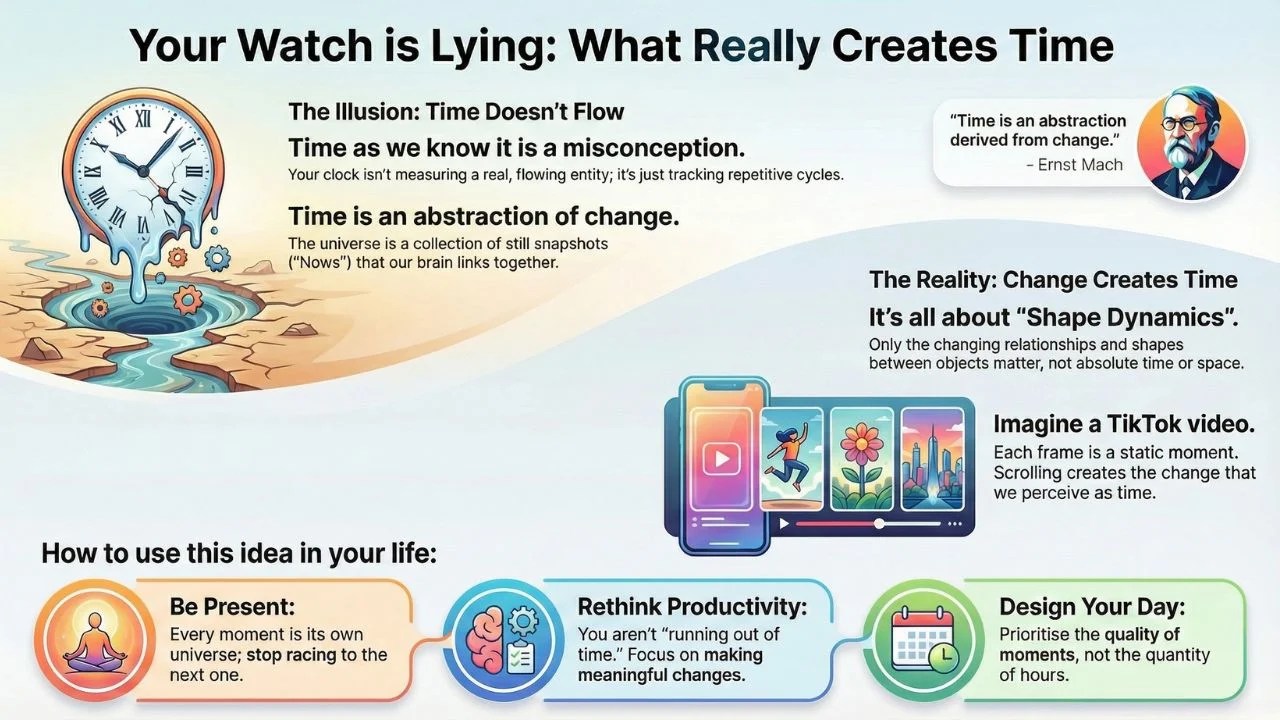
“Time is an abstraction derived from change.” — Ernst Mach

Table of contents
- What Creates Time? Time isn’t ticking. You are.
- Time Isn’t What You Think
- What Makes Change?
- The Janus Point: The Universe’s Mirror Self
- Time Doesn’t Flow. You Do
- Shape Dynamics: The Engine Behind It All
- Entropy & the Arrow of Time: Rethinking Disorder
- The Brain’s Role: Time Capsules in Your Head
- So, How Can You Use This?
- Related articles
- Frequently Asked Questions
- Final Takeaway: Time Is a You Problem
What Creates Time? Time isn’t ticking. You are.
We’ve been trained to think of time as this smooth, continuous flow. Hours, minutes, seconds. They are all perfectly marching ahead like soldiers on a drill.
But, is that what’s actually happening?
Physics says no. Or at least, not in the way your phone’s clock wants you to believe.
So what does create time?
Time Isn’t What You Think
Julian Barbour! A physicist who’s basically been ghosting the mainstream science crowd for decades (by choice), thinks time is a lie. Not in a conspiracy way, but in a very real, math-backed way.
He argues:
- Time doesn’t exist independently.
- What we call “time” is just how we see change.
- The universe is a collection of moments, like snapshots.
- We feel time because of how our brain stitches those snapshots together.
In short: Change creates time. Not the other way around.
What Makes Change?
Now we’re cooking.
Barbour and his crew used a model of three particles forming a triangle. When that triangle changes shape, that’s a new moment. A new “now.”
So,
- Time = change in relationships between things.
- Each unique shape = an instant.
- No shape change? No time.
Think of TikTok videos. Every frame is a moment. You scroll, and the moments change. That scrolling is change. That’s your time.
The Janus Point: The Universe’s Mirror Self
Barbour flips the script on the Big Bang idea. Instead of a singular explosion ahead, he proposes something called the Janus Point. A moment of highest uniformity.
From this point:
- The universe grows more structured in both directions.
- There’s no “beginning” of time. Just movement away from uniformity.
Imagine throwing confetti. That mid-air moment when it’s all bunched up? That’s the Janus Point. After that, things spread out, form patterns. That’s time, according to Barbour.
Time Doesn’t Flow. You Do
Ever hear someone say, “Time flies when you’re having fun? That’s not time flying. That’s you losing track of change.
Clocks, calendars, and time apps. All of them measure cycles. But they’re not time itself. They’re ways we track repetition.
- Sun rises → Sun sets = Day
- Heart beats → You feel alive = Moment
- TikTok algorithm loops → You lose 3 hours = Relatable
Shape Dynamics: The Engine Behind It All
Barbour’s theory called Shape Dynamics says:
- Forget absolute time, space, or even size.
- Only relative positions (aka shapes) of stuff matter.
Let’s break it down:
- If everything in the universe got bigger at once, you wouldn’t notice. Because the shapes between things stay the same.
- All that matters is how one thing changes relative to another.
So again: what creates time?
The change in relationships.
Not your watch. Not the sun. Just… things rearranging themselves.
Entropy & the Arrow of Time: Rethinking Disorder
You’ve probably heard that entropy (disorder) always increases.
But, the thing which we unnoticed.
- Entropy rules mostly apply to systems in a box (like engines, rooms, or pizzas).
- The universe isn’t in a box.
So Barbour argues that entropy and the famous arrow of time is more of a local rule.
In the grand cosmic picture:
- Order can emerge.
- Complexity can increase.
And that’s exactly what we see. Galaxies, stars, people, TikTok drama, all forming from what used to be basically uniform soup.
The Brain’s Role: Time Capsules in Your Head
Have you ever spaced out for 10 minutes and then thought, where did the time go?
That’s not time going anywhere. That’s your brain not saving enough snapshots.
Barbour suggests:
- Your mind creates the illusion of time from stored moments.
- Like a photo album you keep flipping through.
Your memories create a sequence. That sequence becomes your past. But technically, each moment stands on its own.
So, How Can You Use This?
Okay, science class is cool. But what does this mean for you?
1. Be Present
Every moment is its own universe. Stop racing to the next. Nothing’s “ahead” — there’s only now.
2. Rethink Productivity
You’re not “running out of time.” You’re either changing things or you’re not. Make the change you care about. That’s time well spent.
3. Design Better Days
What if you shaped your day based on quality of moments, not quantity of hours? A single good convo > 3 hours of mindless scroll.
4. Don’t Over-Rely on Clocks
They’re tools. Not truths. Your attention and action are better indicators of “time spent.”
Related articles
Frequently Asked Questions
Barbour says time is created by change. The shifting shapes and relationships between things in the universe.
In a way, Yes!. According to Barbour, there’s no flowing time. It is only individual moments that our brain stitches into a timeline.
It’s a theory where only the relative shapes of things matter. No absolute space. No ticking time. Just shifting configurations.
It’s the point of max uniformity in the universe. From there, things evolve in both directions, creating structure (and our sense of time).
It challenges everything we assume about time, clocks, and the universe. And it flips the script on the Big Bang, entropy, and what it means to “move forward.”
Final Takeaway: Time Is a You Problem
Time doesn’t exist on its own. You do.
You change.
That change is time.
The clock’s just playing catch-up.
Hoomale offers blogs on business, youth mindset, future work, and tech. Stay informed and educated with our captivating reads.
Get notified of our next post via email by signing up with the form below! Follow us on YouTube.
Get your free subscription to Hoomale Newsletter now.
Our fav tools: Coolors, InVideo, Semrush, WordPress, Dreamstime, Epidemic Sound
Disclaimer: Some posts have affiliate links. If you buy through them, we earn a commission at no extra cost to you. We only recommend trusted, high-quality products. Thanks for your support!


Very…good article!
It is always now!
Quote from living in France:
Plus can change, plus c’est la meme chose,🎶