
Estimated reading time: 14 minutes
Algorithmic Thinking! With the world becoming increasingly digital and automated, the younger generations need to develop algorithmic thinking skills.
Algorithmic thinking focuses on step-by-step processes or algorithms to solve problems. Artificial Intelligence (AI) is developing incredibly across the United States and other countries like India, China, and other European countries.

What is Algorithmic Thinking?
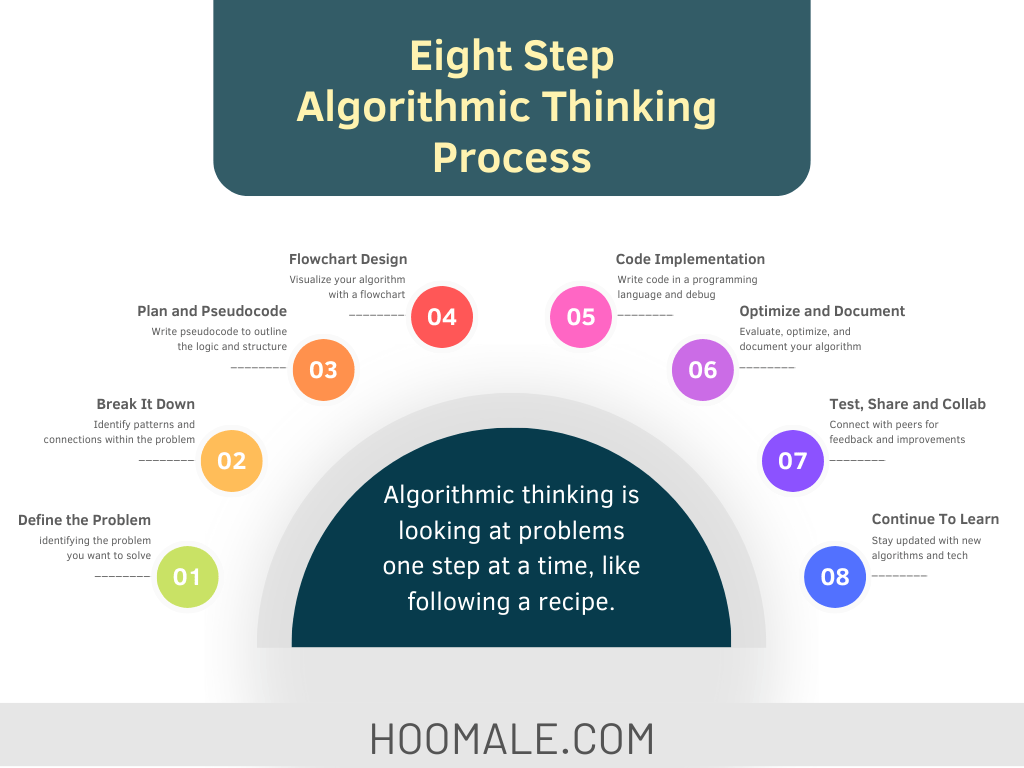
Algorithmic thinking is looking at problems one step at a time, like cooking a recipe. It’s about breaking big problems into smaller parts and figuring out the best way to solve them. It also means looking for patterns and finding ways to do things faster and smarter.
Through algorithmic thinking, one can become a better problem solver. And use creativity to derive cool solutions to everyday challenges in the digital world. It’s like having a superpower that helps us think logically and find the most efficient ways to get things done!
This process applies to various fields, including computer programming, mathematics, and science. When individuals develop algorithmic thinking skills, they become better at logical reasoning and critical thinking. It also helps them understand how technology works and how to create new solutions.
Understanding Algorithms
- Algorithms are step-by-step instructions.
- They’re everywhere: Algorithms are not just for computers.
- Algorithms make things efficient.
- Identifying patterns: Algorithms often involve recognizing patterns or similarities in the problem you’re trying to solve. By finding patterns, you can define a plan to solve the problem.
- Algorithms in technology: Computers use algorithms to do tasks. For example, search engines use algorithms to find relevant information when you type in a query.
Furthermore,
- Different algorithms for different problems.
- Testing and refining: Algorithms can be tested and improved upon. By trying different approaches and analyzing their effectiveness, algorithms get better.
- Algorithmic decision-making: Algorithms can help make decisions based on predefined rules and conditions. For example, recommendation algorithms suggest movies or products based on your preferences.
- Learning from algorithms: Studying algorithms can improve your problem-solving skills and critical thinking. You can apply the concepts of algorithms to various areas of life to find efficient solutions.
- Practice makes perfect: The more you work with algorithms, the better you understand and use them. Practice solving different problems using algorithms to sharpen your skills.
Critical Thinking Vs Algorithmic Thinking
| Algorithmic Thinking | Critical Thinking |
| Focuses on systematic problem-solving using algorithms and logical steps. | Emphasizes analyzing, evaluating, and reasoning to form judgments and make decisions. |
| Involves breaking down complex problems into smaller, manageable steps. | Requires breaking down complex information or arguments to understand their components and relationships. |
| Utilizes pattern recognition to find similarities, trends, and sequences in data or problems. | Encourages identifying patterns, assumptions, and biases in information or arguments. |
| Prioritizes efficiency and improvement in finding the most effective solutions. | Prioritizes accuracy, coherence, and sound reasoning in analyzing information and forming conclusions. |
| Relies on computational tools, coding, and algorithm design to solve problems. | Relies on critical questioning, evidence evaluation, and logical reasoning to analyze and solve problems. |
| Used extensively in computer science, data analysis, and automation. | Used in various domains, including research, decision-making, and problem-solving in diverse fields. |
| Enables automation, predictive modeling, and efficient data processing. | Promotes informed decision-making, effective problem-solving, and informed judgments. |
| Can be learned through studying algorithms, coding, and computational thinking. | Can be developed through practice, logical reasoning, and exposure to diverse perspectives. |
| Encourages a structured, step-by-step approach to problem-solving. | Encourages open-mindedness, skepticism, and considering other perspectives. |
| Applies well to repetitive or deterministic problems with clear rules and constraints. | Applies to complex and ambiguous problems that need analysis, interpretation, and evaluation. |
Why is Algorithmic Thinking important for Gen Z and Gen Alpha?
Generation Z and Alpha must develop the ability to break down complex problems into smaller, more manageable steps. People with algorithmic thinking skills are better equipped to navigate the technological landscape of the 21st century.
In addition to honing logical, critical, and analytical skills. Algorithmic thinking encourages creativity and innovation in fields like science and engineering.
Like the content? Why not subscribe, it’s free.
Benefits of Algorithmic Thinking for Gen Z and Gen Alpha:
- Enhanced problem-solving skills
- Improved logical reasoning
- Development of computational thinking
- Fostered creativity and innovation
- Increased digital literacy
- Future-proof skills
- Automation and efficiency
- Data literacy and analysis
- Adaptability and agility
- Empowerment and independence
Algorithmic Thinking: Basics for Gen Z and Gen Alpha (Concepts)
Gen Z and Gen Alpha can understand the algorithms working nature and apply them to real-world problems. Just by mastering the below concepts.
Also, it will enhance their problem-solving abilities. It will prepare them for future job opportunities in computer science, data analysis, machine learning, computational ways, and artificial intelligence.
Basic concepts of Algorithmic thinking include the below
- Abstraction
- Pattern recognition
- Decomposition
- Algorithm design
- Efficiency and optimization
- Logical and sequential thinking
- Algorithm evaluation
- Iterative problem-solving
Abstraction:
- Find essential aspects: Locate the core elements of a problem, focusing on the key factors for the solution.
- Simplify complexity: Break down the problem into its fundamental components, disregarding unnecessary details.
- Generalize the solution. Create a generalized representation or model that captures the underlying principles for applying the solution to similar situations.
Pattern Recognition:
- Analyze data/problem: Examine information or problem to find recurring patterns, similarities, or trends.
- Extract the Pattern: Locate the common characteristics or relationships.
- Apply the Pattern: Use the recognized pattern to guide the solution process or make predictions based on the identified relationships.
Decomposition:
- Find the main problem: Understand the overarching problem or task that needs to be solved.
- Break down into subproblems: Divide the main problem into smaller, manageable subproblems.
- Solve each subproblem: Focus on solving each subproblem independently, considering their contribution to solving the main problem.
Algorithm Design:
- Define the problem: Understand the requirements, constraints, and desired outcomes.
- Design logical steps: Determine the sequence of steps needed to solve the problem.
- Refine and optimize: Continuously improve the algorithm, considering efficiency and reducing complexity.
Efficiency and Optimization:
- Analyze problem/task: Understand the resources, time, or steps involved.
- Find bottlenecks: Identify areas causing delays or inefficiencies.
- Optimize the solution: Improve the algorithm to lower resource usage, reduce touchpoints and increase speed without compromising quality.
Logical and Sequential Thinking:
- Build logical flow: Find the sequence of actions needed to reach the desired outcome.
- Follow predetermined order: Execute steps in the established order, building upon the earlier.
- Have consistency and coherence: Make sure decisions align with the logical flow and contribute to the overall goal.
Algorithm Evaluation:
- Determine evaluation criteria: Define factors for assessing the algorithm’s effectiveness, like accuracy, speed, and resource usage.
- Test the algorithm: Execute the algorithm using test cases or real-world scenarios.
- Analyze and refine: Evaluate results, make necessary adjustments, and improve the algorithm’s effectiveness and efficiency.
Iterative Problem-Solving:
- Start with a first solution: Develop a solution based on available knowledge.
- Test and evaluate: Implement the solution, gather feedback, and check effectiveness.
- Refine and iterate: Make adjustments and improvements based on evaluation, repeating the process until you reach an optimal solution.
Automation and Computational Tools:
- Find automation tasks: Recognize repetitive or time-consuming tasks suitable for automation.
- Select appropriate tools: Choose relevant computational tools or programming languages.
- Implement and integrate automation: Use selected tools to automate tasks, integrating them into the workflow for improved efficiency and productivity.
Stay connected with Hoomale to access free articles about Generation Alpha, Corporate Culture, Emerging Tech, Thought Leadership, and Human Behaviour.
Real Life Examples of Algorithmic Thinking
Algorithmic thinking has unlimited applications, from computers and technology to our daily lives. From following a recipe to using navigation apps, Algorithmic Thinking is ubiquitous in our everyday activities. For instance,
- Cooking a recipe:
- When cooking, follow each step of the recipe.
- Add ingredients in the right order.
- Make changes if needed for taste or health.
- Solving a Rubik’s Cube:
- Look at the colors and patterns.
- Solve it step by step.
- Use known moves to fix each layer.
- Planning a daily schedule:
- List your tasks.
- Do the most important ones first.
- Think about what depends on what and when things are due.
- Playing a musical instrument:
- Break the music into small parts.
- Practice each part one at a time.
- Then join them together and play the full piece.
- Searching for information online:
- Type your question into a search engine.
- It uses rules to find and show the best results.
- You pick the most useful ones.
- Solving a math problem:
- Read the problem carefully.
- Split it into smaller steps.
- Use math rules or formulas to solve it.
- Building with LEGO bricks:
- Follow the guide step by step.
- See how pieces fit together.
- Change the design if you want something different.
- Planning a travel route:
- Choose the best way to go.
- Think about distance, traffic, and stops.
- Pick the fastest or most fun path.
- Playing chess:
- Think ahead before moving.
- Guess what the other player does.
- Use smart moves to win.
- Debugging a computer program:
- Find where the error is.
- Check each part of the code.
- Fix the problem step by step.
Algorithmic Thinking and Coding for Kids
Learning algorithmic thinking and coding can help children develop logical reasoning, problem-solving skills, creativity, and adaptability. These skills are valuable for future careers in technology and for a profession that requires analytical thinking and problem-solving abilities.
As more industries become digitized, algorithmic thinking and coding will be fundamental skills needed in the workforce.
Resources are available for children to learn algorithmic thinking and coding, including online courses, coding camps, and educational games.
Here is a list that you can try,
Solving Strategies to Develop Algorithmic Thinking Skills in Children
Developing algorithmic thinking skills requires a multifaceted approach that involves practice, foundational knowledge, and collaboration.
Along with problem-solving, developing a strong foundation in math and logic is also essential for algorithmic thinking.
It involves learning the mechanics of algorithms through computer programming languages, like Python or Java.
Engaging in activities that need critical thinking skills, like puzzles or games, can further help improve algorithmic thinking abilities.
Collaborating with others on projects can also give valuable insights and perspectives for problem-solving.
Gamification and Puzzles
Gamification and puzzles are effective ways to develop algorithmic thinking skills in children. Kids can learn valuable skills while having fun by turning problem-solving into a game. Games like Minecraft, Scratch, and CodeCombat can help kids learn programming concepts in a fun and engaging way.
Also, these games allow players to experiment with code and see the real-world outcomes of their actions. It helps them understand how algorithms work.
Puzzles like Sudoku, Rubik’s Cube, and logic puzzles can improve problem-solving and critical thinking skills. These activities need careful analysis of patterns and relationships, key components of algorithmic thinking.
Project-based Learning
Project-based learning is a powerful teaching method that enables students to develop algorithmic thinking skills through hands-on projects. Students can apply the algorithmic concepts they have learned in a practical setting by working on real-world problems.
Furthermore, this approach allows them to explore and innovate solutions using algorithms. Project-based learning also encourages critical thinking, problem-solving skills, and collaboration among students.
Teachers can guide their students through project-based learning by providing support and feedback.
Moreover, teachers can motivate their students by showing them how algorithmic thinking skills applies in various fields.
Computational Thinking Tools and Resources
Computational thinking tools have become essential for developing algorithmic thinking skills in young learners.
Also, these tools give interactive and engaging platforms for learning programming concepts. And help students understand the practical applications of algorithmic thinking.
Furthermore, Scratch, Code.org, and Khan Academy are popular computational thinking resources that offer problem-solving challenges to enhance a child’s algorithmic thinking abilities.
So, parents and educators can use these tools to supplement traditional classroom instruction and encourage independent learning.
Check the below resources for a literature review:
Common Challenges in Developing Algorithmic Thinking Skills
Challenges are everywhere when we intend to learn something new. It must not slow us down. Here are some common roadblocks.
- Lack of Access to Technology
- Resistance to Change in Educational Systems
- Limited Exposure to Real-World Problems
Often Asked Questions
Algorithmic thinking applies in fields like finance, engineering, and healthcare for data analysis and decision-making. Practicing algorithmic thinking can improve critical thinking skills and prepare individuals for tech, software engineering, and STEM fields. So, it is an essential skill that can enhance problem-solving abilities and overall effectiveness in various areas of life.
Algorithms are everywhere, and we use them daily without even realizing it. Examples include,
– recipes for cooking, Google’s search algorithm for finding information online.
– social media algorithms (Facebook, Instagram, TikTok) that decide what content we see in our feeds.
– navigation apps like Google Maps or Waze that use algorithms to determine the fastest route to our destination.
Learning algorithmic thinking can help future career prospects by developing critical thinking skills. These are increasingly important in many industries like technology, finance, and healthcare. Knowledge of algorithms and programming languages can be valuable in various job roles.
Furthermore, algorithmic thinking can help individuals solve complex problems efficiently, improving productivity and job performance. As technology advances, the ability to think algorithmically will become even more critical in the workforce.
Algorithmic thinking is a problem-solving process that involves breaking down complex problems into smaller, more manageable steps. It helps develop critical thinking skills and improves problem-solving abilities.
This thinking applies to various fields like computer science, engineering, mathematics, and everyday life. Individuals can approach problems logically and systematically, leading to more efficient and effective solutions by mastering algorithmic thinking.
Gen Alpha, born after 2010, is still young. Their learning style is not fully understood yet. But, they are known to be digital natives or digital handshakers comfortable with technology from a very young age. They prefer interactive and visually stimulating educational content over traditional lectures.
To adapt to the needs of Gen Alpha, educators should consider incorporating technology and interactivity in their teaching ways. It includes using educational apps or games and providing hands-on activities encouraging exploration and experimentation.
No, Gen Z and Gen Alpha are not the same. Gen Z refers to individuals born between 1996 and 2010, while Gen Alpha refers to those born after 2010. Both generations are considered digital natives and are growing up with technology.
Understanding algorithmic thinking is necessary for both generations as technology continues to shape our world. But, there are distinct differences between the two generations. We must look at when it comes to marketing and communication strategies.
To succeed in the future. Members of Generation Z and Alpha will need a range of skills. This includes critical thinking, problem solving, digital literacy, technological proficiency, communication, collaboration, deep learning, adaptability, emotional intelligence, ethics, and empathy.
These skills will be essential for navigating an increasingly complex world evolving due to technology and global challenges. As such, it is necessary to foster these skills to make sure that individuals understand what lies ahead.
Remember, you are in an exciting era of progress that the earlier generations could not explore.
There are many ways to learn more about algorithms. You can consider taking an online course or enrolling in a computer science degree program. Reading books on algorithms, like “Introduction to Algorithms” by Cormen, Leiserson, Rivest, and Stein, can also be helpful.
Moreover, participating in coding challenges and competitions is another great way to practice using algorithms.
Finally, millennial blogs and social media accounts of experts in the field, can give insights on algorithmic thinking.
Conclusion
As the world relies on technology, algorithmic thinking is essential for individuals of all ages.
Generation Alpha and Gen Z will need many skills to succeed in future higher education. This includes critical thinking, problem-solving, digital literacy, machine learning, and technological proficiency.
Moreover, learning about algorithms can be done through online courses, degree programs, reading books, participating in coding challenges and competitions.
So, you can be better prepared for what lies ahead by fostering these skills. Stay updated on algorithmic thinking by subscribing to relevant blogs and social media accounts.
Hoomale offers blogs on business, youth mindset, future work, and tech.. Stay informed and educated with our captivating reads.
Get notified of our next post via email by signing up with the form below! Follow us on YouTube.
Get your free subscription to Hoomale Newsletter now.
Disclaimer: Some posts may have affiliate links. If you buy through them, we may earn a commission at no extra cost to you. We only recommend trusted, high-quality products. Thanks for your support!


