
So, how to rethink what you think? You can’t stop thoughts from popping up, but you can change how you see them. Cognitive reframing helps you take a stressful, self-critical, or negative thought and look at it differently through a calmer, truer lens.
I am not talking about “positive thinking.” Instead we will discover realistic thinking.
For Gen Alpha teens, reframing is a way to pause, breathe, and think with balance. Because their lives are intertwined with screens, fast content, and constant comparison.
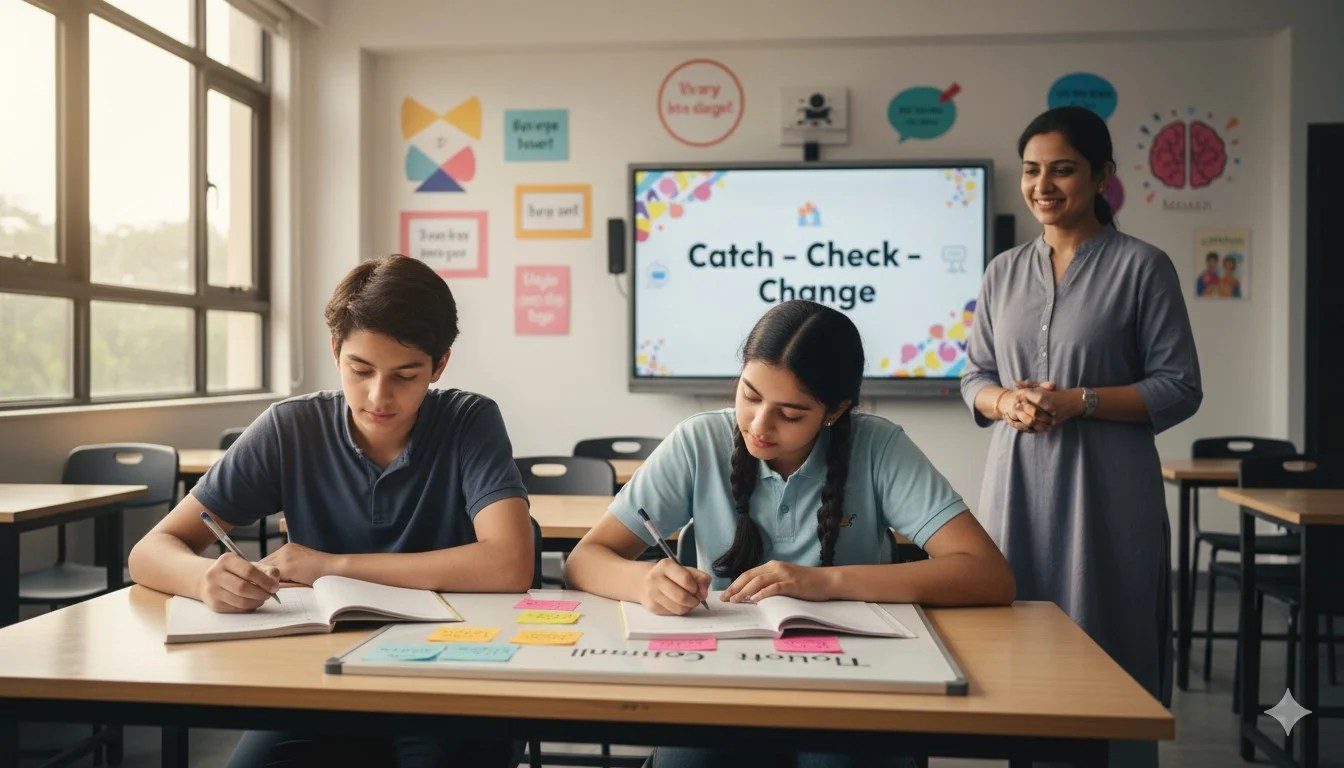
Table of contents
How it works (the quick science bit)
Psychologists call this process cognitive restructuring, a part of Cognitive Behavioral Therapy (CBT). It teaches your brain to notice distorted thoughts. Just like “I failed, so I’m a fool”. And replacing them with more accurate ones like “That test was tough, but I can prepare better next time.”
Studies show CBT and reframing improve teen emotional regulation, confidence, and resilience.
The Gen Alpha difference
Teens today learn differently. They scroll, swipe, and see patterns fast. Long lectures or heavy self-help books? Definitely, they are not their thing. That’s why reframing works best for them when it’s quick, visual, and interactive.
3 quick reframing tools for 13–15-year-olds
1. the “catch-check-change” method
When to use: When you spiral into “always” or “never” thinking.
Steps:
- Catch the thought → “I always mess up.”
- Check it → “Really? Always? Or just this once?”
- Change it → “I made a mistake, but I’m improving.”
Bonus tip: Write the new thought on a sticky note or save it as your lock screen for a day.
2. the “thought detective” worksheet
When to use: When emotions feel too heavy to untangle.
How it works: You investigate your thoughts like a detective.
| Situation | Thought | Feeling | Truth Check | Reframe |
|---|---|---|---|---|
| Friend didn’t reply | “She’s ignoring me.” | Hurt, angry | She might be busy | “Maybe she’s offline; I’ll check tomorrow.” |
Download printable template: Thought Detective Worksheet PDF
Parent tip: Ask your teen, “What evidence supports or challenges that thought?” rather than saying “Don’t think like that.”
3. the “mirror mantra” (two-minute reflection)
When to use: Before a big day like exams, performances, competitions.
How to do it:
- Stand before a mirror.
- Say out loud a thought that’s been bugging you.
- Now rephrase it as if you’re advising a friend.
- Repeat the new line once more, slower, looking into your own eyes.
Example:
Thought: “I’ll probably fail.”
Rephrase: “I’ve studied. I might not know everything, but I know enough to try.”
(In Hindi: “Main tayyaar hoon. Mujhe sab nahi aata, lekin koshish karne ki himmat hai.”)
Real-life examples teens relate to
| Situation | Common Thought | Reframe |
|---|---|---|
| Didn’t get enough likes on a post | “I’m not interesting.” | “My value isn’t measured by likes.” |
| Friend group left you out | “No one wants me.” | “Sometimes people do things without meaning to hurt.” |
| Test marks dropped | “I’ll never be good at this.” | “One result doesn’t define me. I can learn what went wrong.” |
One-minute journal prompt
“Think – Flip – Feel” Mini Journal
| Step | Question | Example |
|---|---|---|
| Think | What’s one tough thought you had today? | “Everyone’s smarter than me.” |
| Flip | What’s another possible way to see it? | “I can learn from them.” |
| Feel | How do you feel after the flip? | “Lighter.” |
Download printable template: Think–Flip–Feel Journal PDF
A note for parents
You don’t have to correct your teen’s thinking even though that’s what you think is right. For certain thing just mirror them. Ask open-ended questions:
- “What made you feel that way?”
- “Can there be another side to that?”
- “What might a friend say if they were in your place?”
Your calm tone gives them permission to rethink and not defend.
So, what’s the takeaway
Reframing doesn’t erase negative thoughts. It helps you meet them with clarity instead of reaction.
For Gen Alpha teens, it’s about training it to see more options. And that’s real strength.
Related articles
Frequently Asked Questions
Cognitive reframing helps teens change the way they see stressful or negative thoughts. Instead of reacting emotionally, they learn to look at situations with balance and clarity.
Gen Alpha faces constant digital pressure and fast comparisons online. Reframing helps them pause, question impulsive thoughts, and respond with awareness instead of stress.
Yes. Parents can guide by asking gentle questions like, “What else could this mean?” rather than correcting thoughts directly. It builds reflection, not resistance.
Catch–Check–Change, Thought Detective Worksheet, and the Think–Flip–Feel Journal are short and easy exercises that take less than five minutes.
Not at all. Reframing acknowledges emotions first, then shifts the perspective. It helps express feelings without being trapped by them.
Hoomale offers blogs on business, youth mindset, future work, and tech. Stay informed and educated with our captivating reads.
Get notified of our next post via email by signing up with the form below! Follow us on YouTube.
Get your free subscription to Hoomale Newsletter now.
Our fav tools: Coolors, InVideo, Semrush, WordPress, Dreamstime, Epidemic Sound
Disclaimer: Some posts have affiliate links. If you buy through them, we earn a commission at no extra cost to you. We only recommend trusted, high-quality products. Thanks for your support!


