
Estimated reading time: 10 minutes
In the high-stakes world of decision-making, 45% of professionals report being stuck in analysis paralysis at least once a month.
Think about that. Hours of research, mountains of data, and yet, no meaningful action. This is a career roadblock that silently erodes potential and momentum.
Decision paralysis transforms what should be strategic thinking into an endless loop of overthinking. This is where every potential choice becomes a labyrinth of hypothetical outcomes.
But, brilliant professionals aren’t those who collect the most information. They’re the ones who know how to transform insights into decisive, calculated moves.
Table of contents
What Is Analysis Paralysis?
Analysis paralysis is the process of overthinking a decision, leading to inaction. It occurs when we struggle to make clear choices due to excessive analysis and overthinking. The trap of analysis paralysis often arises during vital decision-making processes, hindering progress and growth.

The curse of analytical paralysis is everywhere. It whispers doubt and drowns decisions in an endless sea of “what ifs.” Choice paralysis, its close cousin, thrives on abundance, turning a buffet of options into a paralyzing feast of indecision.
Caught in their clutches, we become tangled in webs of analysis and analysis of analysis. We dissect every possibility until movement feels like scaling Mount Everest in flip-flops.
But, before we resign ourselves to a lifetime of frozen inaction, let’s consider this. Is it the analysis itself that cripples us, or the fear of making the wrong choice? Perhaps the key lies not in banishing analysis entirely, but in learning to dance with it.
A measured waltz, not a frenzied tango, could guide us through the maze of options. It reveals the strengths and weaknesses of each path without leaving us dizzy and adrift.
So, acknowledge the value of careful consideration, but don’t let it morph into a monster. Embrace the analysis, but don’t let it paralyze.
Remember, sometimes the best choice is simply to choose, and trust that even a misstep is a detour on the journey to progress.

Traits of Analysis Paralysis
There are a few easily identifiable traits of analysis paralysis. Here is a quick list,
- Overthinking and Indecision
- Rumination
- Dealing with too much information
- Trying to be perfect
- Fear of failure
- Unable to prioritize
- Stuck at one thought or a set of thoughts
- Questioning your choices

What Does Analysis Paralysis Feel Like?
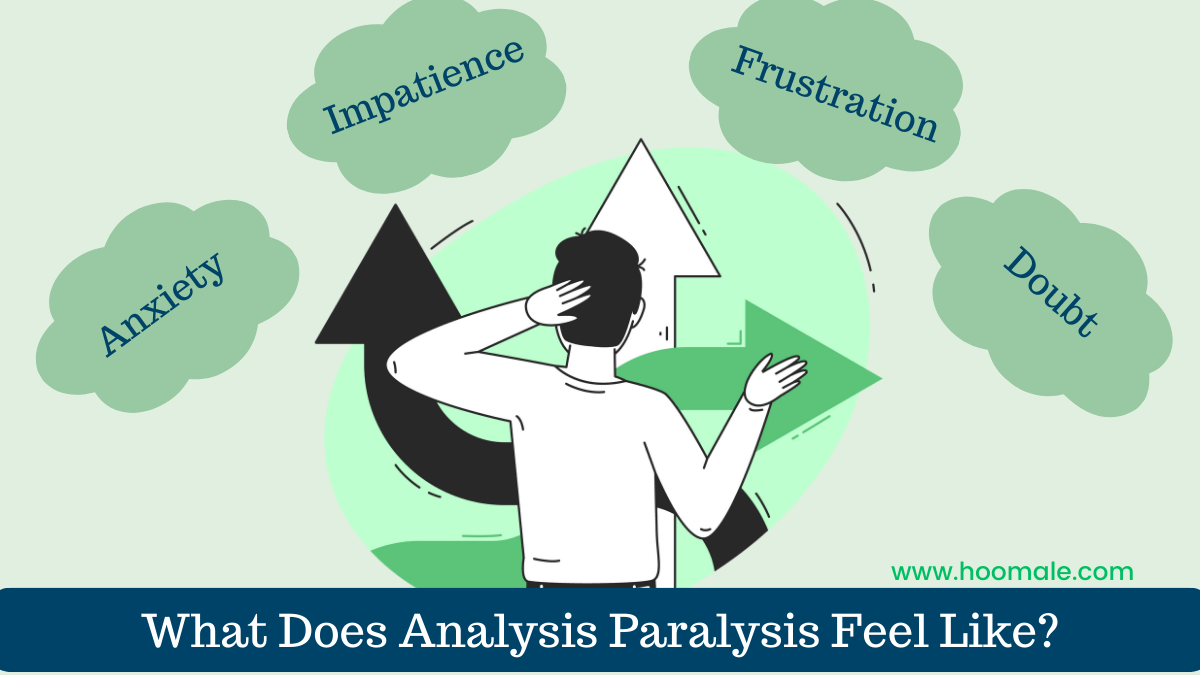
Analysis Paralysis feels like being stuck in a mental loop, delaying a decision. It creates anxiety, impatience, frustration, and doubt. It’s like being trapped in overthinking without a clear idea.
As you sit there, staring at the screen, your mind races with a million thoughts. You find yourself lost in a labyrinth of information, unsure which path to take. The weight of indecision bears on your shoulders, paralyzing you from moving forward. This is analysis paralysis.
It’s a frustrating feeling, isn’t it? Your mind becomes consumed by doubts and what-ifs, leaving you trapped in uncertainty.
How Analysis Paralysis Upsets Your Mind?
Analysis paralysis is a multi-stage mental takeover hijacking your decision-making process.
Here’s how it unfolds:
1. The Spark
It often starts with a simple dilemma, a choice to make. But unlike usual decisions, something triggers an “analysis switch” in your brain. Maybe it’s an important decision, a fear of making the wrong choice, or an abundance of information.
2. The Tunnel Vision
Instead of taking a broad overview, your mind zooms in on details. Every option branches out into sub-options, each with its potential consequences. It’s like peering through a magnifying glass, losing sight of the bigger picture.
3. The Rabbit Hole
This analysis triggers fear and uncertainty. You delve deeper, searching for information to alleviate the fear, but instead, you see more uncertainties. It’s like falling down a rabbit hole of “what ifs,” each leading to deeper anxiety.
4. The Overanalyzing Loop
With every new piece of information, the decision becomes more complex. You start comparing and contrasting every variable, every nuance, leading to even more doubt. Imagine being stuck in a hamster wheel, constantly circling the same decision without progress.
5. The Paralysis Point
At a certain point, the mental overload becomes overwhelming. Your brain experiences decision fatigue, making it impossible to choose any option. You reach a mental cliff, frozen in indecision, not able to take the next step.
6. The Spillover Effect
Analysis paralysis doesn’t stay confined to one decision. It starts spilling over, affecting other areas of your life. You become indecisive, procrastinate on other tasks, and feel drained from the constant mental churning. It’s a mental fog spreading, impacting you.

Examples of Analysis Paralysis
- Example 1: Let’s say you are at the store, trying to choose a new pair of shoes. You find yourself standing in the aisle, comparing every single option and analyzing the pros and cons of each one. You start thinking about how each shoe will match different outfits. How comfortable they will be, and what others will think of your choice. Hours go by, and you still haven’t made a decision. Your mind is trapped in the tunnel vision of overanalyzing every detail, losing sight that it’s just a pair of shoes.
- Example 2: Imagine you are planning a vacation with your friends. Instead of enjoying the anticipation and excitement of the trip, you find yourself lost in a sea of options. You spend countless hours researching destinations, comparing prices, reading reviews, and analyzing every minute detail. The more research you do, the more overwhelmed you feel. Suddenly, what was supposed to be a fun and relaxing vacation became a stressful and draining task. This has taken hold, robbing you of the joy of planning a trip.
- Example 3: Let’s say you have a career decision to make. You have two job offers, each with its own set of benefits and drawbacks. Instead of choosing based on your gut feeling or the alignment with your long-term goals, you find yourself consumed by overanalysis. You start creating elaborate pros and cons lists, researching the companies extensively, and seeking opinions from everyone you know. The fear of making the wrong decision paralyzes you.
- Example 4: For some, even making everyday decisions is painful, like what to eat for lunch or dinner. You spend excessive time scrolling through countless restaurant menus, reading reviews, and comparing prices. Your hunger grows, but so does your indecision. The simple act of choosing a meal becomes an overwhelming task as you analyze every option to the point of exhaustion.
The Effects of Analysis Paralysis
The repercussions of analysis paralysis are profound, to list,
- Missed opportunities
- Waste of time
- Impact on personal and professional growth
- Making wrong decisions
- Failed relationships
- Feelings of stagnation and unfulfillment
How to Stop Analysis Paralysis?
Time needed: 5 minutes
Here is a 6-step process to stop Analysis Paralysis from our experience.
- Step 1: Catch yourself in the act.
We all overthink sometimes, so the first step is recognizing the warning signs. Are you overwhelmed, glued to endless research tabs, or having constant butterflies in your stomach? Yep, those are red flags.
- Step 2: Know your why.
Before diving into a decision abyss, ask yourself the big question: what do you want to achieve here? Knowing your goal helps focus your searchlight and avoid getting lost in irrelevant details.
- Step 3: Information diet, anyone?
Remember, endless options aren’t always your friend. Set a research deadline and stick to it. Treat it like a delicious dessert. Savor the good stuff, but don’t overindulge!
- Step 4: Time to break the time loop.
Let’s face it. Some decisions can take years if we let them. Give yourself a realistic time limit for weighing options and choosing your path. Remember that progress is key, even if it’s not a lightning-fast decision.
- Step 5: Imperfection is the new black.
Let’s ditch the pressure to find the “perfect” choice. Sometimes, “good enough” is just fine, and making a decision, even if it’s not ideal, gets you moving forward. Remember, life is a messy adventure, so embrace the imperfect ride!
- Step 6: Learn from your detours.
Every decision, good or not, is a learning opportunity. Take some time to reflect on what worked and what didn’t. This knowledge becomes your compass, guiding you to smoother sailing next time.
Related articles
Frequently Asked Questions
One effective way to avoid analysis paralysis is by defining your decision-making process. Utilize a decision-making framework or checklist to assess options and focus on relevant data while limiting the amount of information you consume. Embrace calculated risks and make decisions, even if they aren’t perfect.
Signs of analysis paralysis include excessive research and planning without taking action, feeling overwhelmed by options or decisions, procrastination, and spending more time thinking than doing. Break free from analysis paralysis by recognizing these symptoms and taking steps to move forward.
The root cause of analysis paralysis stems from fear, uncertainty, and feeling overwhelmed by information. It is also to perfectionism and the fear of making the wrong decision. To avoid this, set clear goals, prioritize tasks, and seek outside input if needed.
Limit your options and focus on the most vital factors. Take action and make decisions, even if they are not perfect. Remember to fail happily and make it a learning opportunity.
Fear, uncertainty, overthinking, and the need for perfection contribute to this.
It is overthinking and indecision. Here a company becomes too focused on gathering information, leading to a failure to take action. This can result in missed opportunities and wasted resources.
To avoid, businesses should prioritize tasks, stick to goals, and decide based on the best available information.
Overthinking and analysis paralysis are related but not the same. It is when you are stuck in decision-making due to excessive analysis. Overthinking can occur in various aspects of life, not just big decision-making.
Taking action is the opposite of analysis paralysis. You can break free from the cycle of overanalyzing by avoiding overthinking and trusting your gut. Setting clear goals and deadlines can also help you stay focused and make decisions more efficiently.
Conclusion
Breaking free from analysis paralysis is about mastering it. Implement these strategies with intention, and watch how quickly your decision-making transforms from hesitant to heroic.
Remember, every moment spent overthinking is a moment stolen from execution. Trust your expertise, embrace calculated risks, and understand that movement. Even imperfect movement always beats perfect paralysis.
The most successful leaders are those who make timely choices and adapt quickly.
Your professional growth depends not on endless analysis, but on your courage to act.
Hoomale offers blogs on business, youth mindset, future work, and tech. Stay informed and educated with our captivating reads.
Get notified of our next post via email by signing up with the form below! Follow us on YouTube.
Get your free subscription to Hoomale Newsletter now.
Our fav tools: Coolors, InVideo, Semrush, WordPress, Dreamstime, Epidemic Sound
Disclaimer: Some posts have affiliate links. If you buy through them, we earn a commission at no extra cost to you. We only recommend trusted, high-quality products. Thanks for your support!


